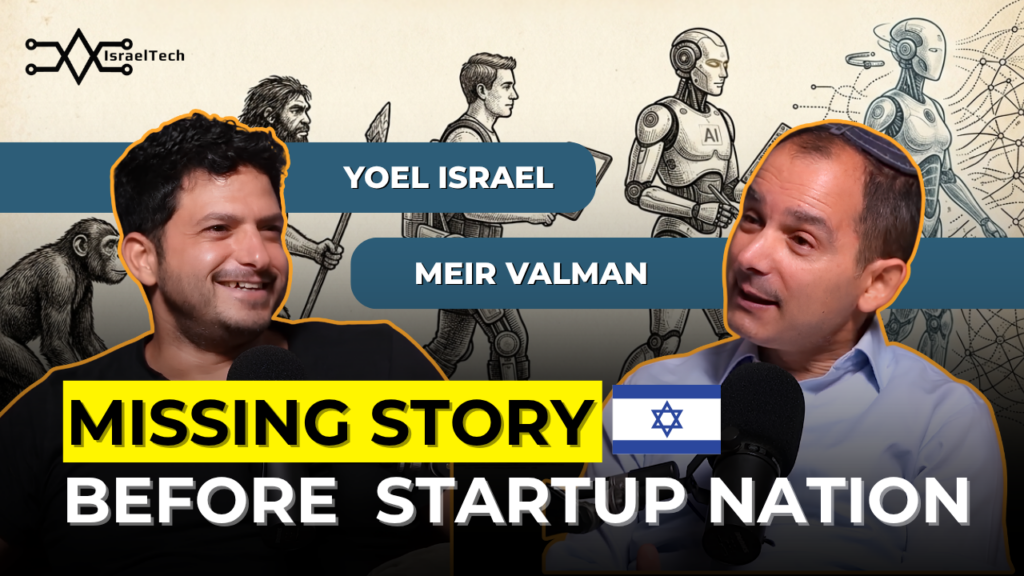
Three-time founder Hila Goldman-Aslan, managing partner at RUNI Ventures, joins Yoel Israel to discuss her move from founder to investor, how a university-backed fund works, and what Israeli founders miss in VC meetings.
Hila Goldman-Aslan spent more than 15 years building startups before moving to venture capital. Her third company, DiA Imaging Analysis, was acquired by Philips in May 2023.
Today she leads RUNI Ventures, the pre-seed and seed fund backed by Reichman University. From that seat, she sees founders with strong technology lose investor interest for reasons that have little to do with their product.
Three Startups and an Exit
Hila studied business and law at Reichman University. An internship at a law firm that represented startups and VCs showed her where she wanted to be, and she soon left law to join a 15-person fintech startup.
Her first company came from a gene therapy technology developed at the Volcani Center. She raised money and ran it for three years, but when the 2008 financial crisis hit, the company could not raise the roughly $20 million it needed. Her second came from Bar-Ilan University: a device that prevented phones from taking pictures inside a room. Investors came in quickly, but the team hit a technical barrier it could not solve, so it returned the remaining money and closed the company.
For her third company, she partnered with Michal Yaacobi, whose master’s research at Ben-Gurion University became the basis for DiA. The company used AI to help physicians analyze ultrasound images, with a focus on cardiac care. Over more than eight years, it grew to 40 people, raised about $25 million, and earned FDA clearance for nine solutions before Philips acquired it. Hila spent two years at Philips integrating the technology, which now runs inside every Philips cardiac ultrasound device.
From Farmer to Hunter
After the acquisition, Hila began investing as an angel and LP and mentoring early-stage founders. She found she loved the investment side. When a private equity firm offered her a CEO role, someone there asked whether she was a farmer, who builds, or a hunter, who invests. She chose to be a hunter.
She wanted a small, early-stage fund where she could still feel like a builder. At RUNI Ventures, which already had 13 portfolio companies when she joined, she told her two employees, “I’m going to run this like a startup because I don’t know how to run things differently.”
The job was harder than it looked from the founder’s side. As a single GP, she has no co-founders to take over development or sales. She handles deal flow, a portfolio that has grown to 16 companies, relationships with LPs, and preparation for the next fund. She also learned that LPs in a VC fund, often family offices, are very different from the investors who back startups.
What a University-Backed Fund Offers
Hila said the Reichman connection gives RUNI Ventures an edge over other small pre-seed funds. The fund built a WhatsApp community of about 200 post-exit founders who graduated from the university. They share deals they are investing in, and RUNI offers them room in its own rounds. The network also includes 26 unicorn founders who can help with due diligence or become design partners, customers, and advisors for portfolio companies.
About 80% of Reichman’s lecturers come from industry, and Hila teaches a venture capital course there herself. Portfolio companies can also take student interns two days a week at no cost. One company brought on eight interns from the international school and built its SDR team around them.
Many founders assume the fund invests only in alumni, and the team works to correct that. Still, 12 of its 16 companies have a connection to the university.
Due Diligence Starts at the First Meeting
The most common mistake Hila sees among Israeli founders is coming to VC meetings unprepared. Many have a first answer for how they will sell their product and who will buy it, but nothing behind it when the follow-up questions come.
Her advice is to do the work for the VC team. “Investors are lazy,” she said, explaining that most funds lack the staff to research everything themselves. Founders should have a slide or document ready for every likely question and rehearse with angels or other investors who will push them. When a question is truly new, saying you will check is better than guessing.
Investors also watch for nuance. Hila pointed to signals such as hesitating before an answer, interrupting a co-founder, and sharing information that contradicts an earlier meeting or document. Early in her third startup, an investor told her to assume every meeting was being recorded. Today many are, and AI makes it easy for a fund to compare what founders said in the third meeting with what they sent before it.
Why Israeli Medtech Is Drawing Attention
Hila tells healthcare founders that purpose is not enough to win over a VC. They need to show how the company will make money. She considers Israel a major medtech hub, with invasive medical devices in particular producing acquisitions worth hundreds of millions of dollars.
She also expects more interest in the sector. With AI making software faster to build, investors are looking more closely at hardware, deep tech, and physical AI, and healthcare sits near the top of that list.
Optimism as a Requirement
Hila believes founders have to be optimistic. They are building something new against the odds and need to keep employees believing through hard periods. She recalled an investor from Insight telling an Israeli audience that Israeli startups barely die at all because founders are so stubborn.
She brings the same outlook to RUNI Ventures. The fund plans three or four more investments while it begins raising a second fund, which she hopes will reach about $30 million with checks of up to $1 million, roughly double the current size of about $500,000. Looking further ahead, she expects the end of the war and an expansion of the Abraham Accords to bring investors back and open a period of five to 10 years of prosperity for Israeli tech.