For many investors outside Israel, the assumption after October 7 was simple.
War creates instability. Instability creates risk. Risk drives investors away.
But according to Yev, a partner at Alumni Ventures focused on Israeli startups, the reality unfolding inside Israel’s economy and tech ecosystem tells a very different story.
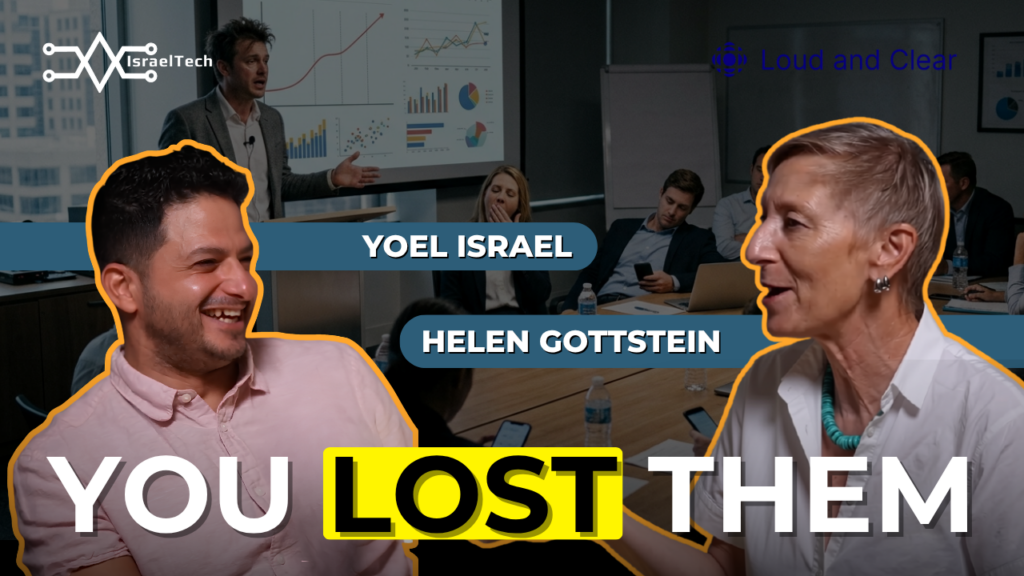
In a recent conversation on Israel Tech with Yoel Israel, Yev argued that many global investors are misunderstanding what has actually happened to Israel over the past two years.
“The irony, and this is the opportunity, is that if you look objectively, Israel has had an enormous de-risking journey over the last two years,” Yev said.
The Gap Between Headlines and Markets
From the outside, Israel has appeared locked in nonstop conflict.
But Yev believes investors who focus only on headlines are missing the broader geopolitical and economic shifts happening underneath.
He pointed to several developments that have reshaped the region since October 7, including the weakening of Hamas and Hezbollah, the fall of Assad in Syria, Israel’s military operations against Iran, and the potential expansion of the Abraham Accords.
Taken together, he sees these developments as part of a larger strategic shift that has strengthened Israel’s long-term position rather than weakened it.
At the same time, many global markets are facing uncertainty around valuations, inflation, and slowing returns.
That combination has created what Gelfand describes as a disconnect between perception and reality.
“Valuations are still depressed compared to other markets and compared to history,” he explained. “That’s the dislocation.”
Why Investors Continue to Bet on Israeli Tech
Yev says there are two broad groups of investors entering Israel today.
The first are ideologically motivated investors who want to support Israel’s economy and startup ecosystem.
The second group is focused purely on returns.
“They don’t particularly care about Israel,” he said. “They’re looking for financial returns.”
For that second category, Israel’s startup ecosystem continues to stand out because of its global orientation.
Israeli founders rarely build for a local market. From day one, most startups are designed for customers in the United States, Europe, and international markets.
That global structure has insulated many Israeli companies from local economic shocks.
“Most entrepreneurs and startups build with an international scope,” Yev explained.
He pointed to the performance of the Tel Aviv Stock Exchange since October 7 as one example of how markets have reacted differently than many expected.
Israeli Resilience as an Investment Thesis
One of the strongest themes throughout the conversation was resilience.
Not resilience as branding, but as a measurable pattern investors have seen repeatedly throughout Israel’s history.
“If you look at Israel’s history, every time without exception, Israel comes out stronger and the economy specifically comes out stronger,” Yev said.
He believes that resilience extends directly into the startup ecosystem.
During the interview, Gelfand described a pitch meeting with Israeli founders that was interrupted by missile sirens. The founders briefly left the meeting to enter a bomb shelter before returning.
For the American investors on the call, the experience completely changed how they viewed Israeli founders.
“They were like, you know what? We don’t even need to continue the pitch. We’re all in,” Yev recalled.
How Israeli Venture Capital Is Changing
The discussion also touched on how Israel’s venture capital ecosystem has matured.
Historically, Israeli startups were often associated with relatively early exits.
Strong companies would build quickly, sell quickly, and move on.
Gelfand believes that mindset is changing.
He pointed to major exits and valuations in recent years, including Wiz, CyberArk, eToro, and Via, as evidence that Israeli founders and investors are becoming more willing to build companies at larger global scale.
“Historically, Israel was happy for singles and doubles,” he said. “Now Israel has seen that we can play with the biggest players on the planet.”
That shift is attracting more attention from major global venture firms.
According to Yev, firms like Sequoia, Andreessen Horowitz, Lightspeed, Accel, and Bessemer are continuing to deepen their activity in Israel rather than pulling away from it.
The Future of Israel as a Global Tech Hub
One of the most striking moments in the conversation came when Yev described Israel as potentially becoming “the future of Silicon Valley for the world.”
His argument was not based only on talent.
It was also about concentration.
Israel’s small geographic size, tight founder networks, military connections, and collaborative culture create unusually dense ecosystems for innovation.
According to Yev, that concentration creates powerful network effects.
“What’s different is how open, welcoming, and helpful the Israeli ecosystem is,” he said while describing his experience building relationships inside Israel’s venture community.
At a time when many global investors remain cautious, Gelfand believes Israel’s strongest years may still be ahead.
“My expectation is that over the next 10 years, Israel will be proven as one of the best financial investments in the world,” he said.